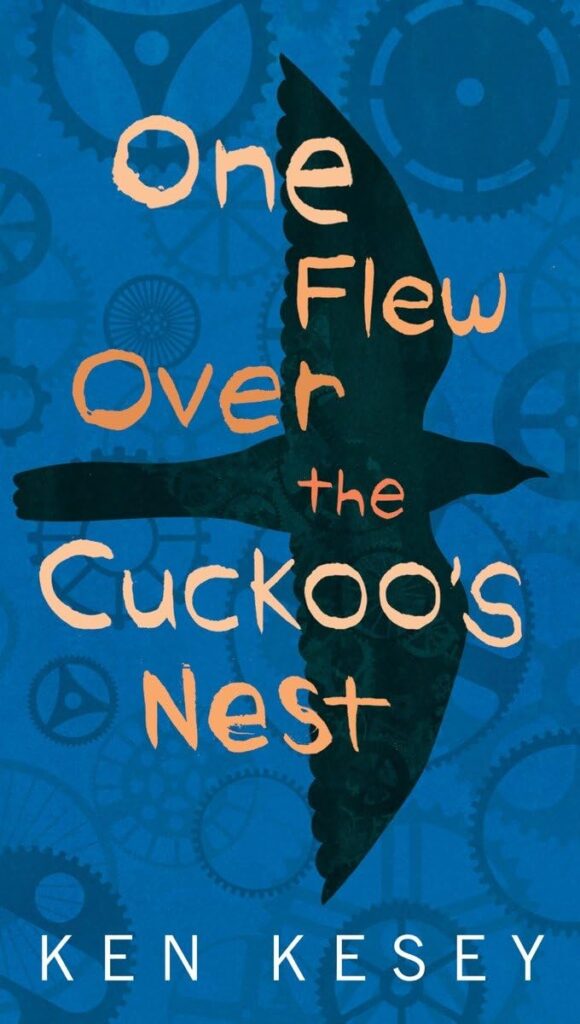

One Flew Over the Cuckoo’s Nest by Ken Kesey
About the Author
Ken Kesey was an American novelist and countercultural figure best known for his exploration of authority, individuality, and resistance. Influenced by his experiences working in a psychiatric hospital and participating in government-funded experiments involving psychoactive drugs, Kesey developed a deep skepticism toward institutional power. One Flew Over the Cuckoo’s Nest (1962) became his most influential work, cementing his place as a key literary voice of the 1960s.
Story in Brief
One Flew Over the Cuckoo’s Nest is set in a mental institution where patients live under the rigid control of Nurse Ratched, a symbol of cold, bureaucratic authority. The story is narrated by Chief Bromden, a patient who pretends to be deaf and mute. The arrival of Randle P. McMurphy—a rebellious, loud, and unapologetically free-spirited man—disrupts the ward’s oppressive routine. Through McMurphy’s defiance, the novel explores themes of individuality, conformity, power, masculinity, sanity, and the thin line between treatment and punishment.
Challenges / Bans
The novel has faced repeated censorship due to its challenging content and themes:
United States: Frequently banned or challenged in schools for profanity, sexual content, and depictions of mental illness.
Moral Objections: Criticized for explicit language, sexual references, and perceived vulgarity.
Institutional Critique: Targeted for its harsh portrayal of psychiatric institutions and authority figures, which some viewed as subversive or anti-establishment.
Why It’s Still Important
One Flew Over the Cuckoo’s Nest remains a powerful critique of systems that suppress individuality under the guise of order and care. Its portrayal of institutional control, abuse of power, and the silencing of vulnerable voices continues to resonate in conversations about mental health, authority, and personal freedom. Banning this novel risks silencing a vital examination of how society defines normalcy—and what happens when rebellion becomes the only form of sanity.